
The Pharmacy in Your Kitchen: How Ayurvedic Spices Become Everyday Medicine
Discover how everyday herbs and spices become powerful medicine through the lens of Ayurveda. Learn how ingredients like turmeric, cumin, fennel, and cardamom balance your doshas, ignite digestion, and nourish your body from within. Transform your kitchen into a healing sanctuary where every meal supports vibrant health and soulful living.
🌿 Introduction: When Food Becomes Medicine
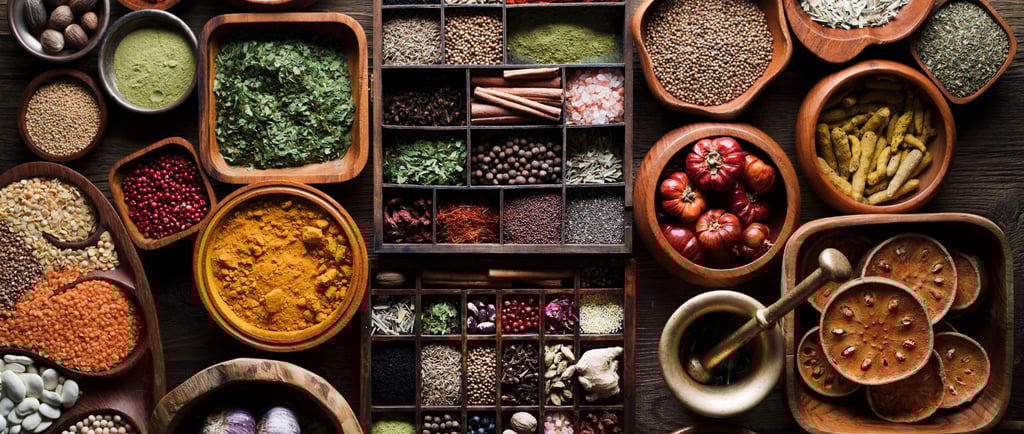
Step into your kitchen and look around — what you see as spices and seasonings, Ayurveda sees as powerful medicines. From golden turmeric to fragrant cardamom, every seed and root holds the ability to balance doṣas, ignite agni (digestive fire), and awaken the body’s innate healing intelligence.
In Ayurveda, the kitchen is not merely a place to cook — it’s a sacred pharmacy. Your spice rack is your first line of defense against imbalance. The wisdom of the ancients reminds us:
“Āhāra-saṃskṛtyaṃ auṣadhaṃ bhavati.”
“When food is prepared and taken correctly, it itself becomes medicine.”
— Charaka Saṃhitā, Sūtrasthāna 27.349
🔥 The Ayurvedic Science Behind Healing Spices
According to Ayurveda, every herb and spice carries six key properties (Ṣaḍ Guṇas or Dravya Guṇas) that influence the body and mind. These qualities determine how a spice behaves from ingestion to assimilation — shaping its medicinal and energetic effects.
Rasa (Taste) – Determines the spice’s immediate impact on the doṣas and agni (digestive fire). Each taste — sweet, sour, salty, pungent, bitter, and astringent — initiates a distinct physiological and emotional response.
Virya (Potency) – Indicates whether the spice has a heating or cooling effect on the body, influencing metabolism, circulation, and energy flow.
Vipāka (Post-digestive effect) – Describes how the substance behaves after digestion, influencing long-term tissue nourishment and elimination.
Guṇa (Quality) – Refers to physical attributes like light/heavy, dry/oily, sharp/soft — qualities that affect how easily a substance is digested and assimilated.
Prabhāva (Unique Energy) – The subtle, often spiritual property that transcends logic — the mysterious power that gives each herb its special healing signature (for example, turmeric’s anti-inflammatory “divine intelligence”).
Karma (Action) – The ultimate effect or therapeutic outcome of the herb — how it acts upon the body, mind, and consciousness. Karma reveals whether a spice detoxifies, rejuvenates, sedates, energizes, or balances specific organs and systems.
Together, these six principles define how each spice functions medicinally — whether it kindles digestion, calms inflammation, supports the nervous system, purifies the blood, or awakens subtle energies that guide healing on deeper levels.
🕉️ The Role of Spices in Balancing Doshas
Vata (air & ether): pacified by warming, grounding spices like ginger, cumin, and asafoetida.
Pitta (fire & water): soothed by cooling spices like coriander, fennel, and cardamom.
Kapha (earth & water): balanced by stimulating spices like black pepper, clove, and mustard seed.
By adjusting spices seasonally and according to your dosha, you maintain agni — the digestive fire that is central to all health.
“When agni is balanced, one lives a long and healthy life. When agni is disturbed, disease follows.” — Charaka Saṃhitā, Chikitsāsthāna 15.44
🌺 Five Foundational Ayurvedic Spices and Their Healing Powers
🌼 1. Turmeric (Haridra)
Qualities: Bitter, pungent, heating.
Actions: Anti-inflammatory, blood-purifying, liver-protective, antimicrobial.
Ayurvedic Insight: Balances Kapha and Pitta, promotes radiant skin and immunity.
Modern Research: Curcumin, turmeric’s main active compound, has shown anti-inflammatory and antioxidant properties in numerous clinical studies (PubMed ID: 17569205).
🌿 2. Cumin (Jeeraka)
Qualities: Pungent, slightly bitter, light, and dry.
Actions: Improves digestion, relieves gas, enhances nutrient absorption.
Balances: Vata and Kapha.
Tip: Roast lightly before adding to meals — it kindles agni without overheating the body.
🍃 3. Fennel (Madhurika / Shatapushpa)
Qualities: Sweet, cooling, light.
Actions: Eases bloating, soothes acid reflux, improves lactation, calms the mind.
Balances: Pitta and Vata.
Modern Research: Fennel seeds exhibit carminative and antispasmodic effects (Journal of Ethnopharmacology, 2003).
🌸 4. Black Pepper (Maricha)
Qualities: Pungent, hot, sharp, light.
Actions: Enhances bioavailability of nutrients and herbs (especially turmeric), melts āma (toxins).
Balances: Kapha and Vata.
Modern Note: Piperine increases curcumin absorption by up to 2000% (Planta Medica, 1998).
🌺 5. Cardamom (Ela)
Qualities: Sweet, cooling, light, aromatic.
Actions: Refreshes breath, calms Pitta, reduces acidity, supports mental clarity.
Balances: Pitta and Vata.
Spiritual Insight: Considered a sattvic spice, it uplifts the heart and purifies subtle energies.
🫖 How to Transform Your Cooking into Healing
Cook with intention – infuse gratitude and awareness while preparing food.
Use freshly ground spices – potency diminishes with time and light exposure.
Match spice to season – warming in winter, cooling in summer.
Layer spices mindfully – fry aromatic spices in ghee to activate their medicinal oils.
Listen to your body – Ayurveda is not one-size-fits-all; your taste and comfort guide healing.
💛 From Kitchen to Consciousness
The Ayurvedic way of eating reminds us that healing doesn’t always come from pills or prescriptions — it often begins with what’s simmering in your pot. Each spice is a teacher, showing us how to live in rhythm with nature, how to balance fire and calm, and how to bring consciousness into every bite.
“Ahāra eva auṣadham — Food itself is medicine.”
In honoring this truth, we transform our kitchens into sanctuaries and our meals into sacred rituals of self-healing.
✨ Key Takeaways
Every spice carries energetic, physical, and spiritual healing properties.
Properly used, spices ignite digestion, balance doshas, and prevent disease.
Cooking consciously turns nourishment into medicine for both body and soul.
Connect
Questions? Reach out anytime, we're here.
© 2026. All rights reserved.