Beyond the Body: Understanding the Layers of Your Existence
Most of us grow up believing a very simple story about who we are. “I am this body.” “I am this mind.” “I am my name, my history, my achievements, my wounds.” From the moment we are born, the world reinforces this idea. We are taught to care for the body, train the intellect, manage emotions, and define ourselves by roles—daughter, son, partner, professional, parent. Rarely does anyone pause to ask a deeper question: Who is the one experiencing all of this? Let us explore...
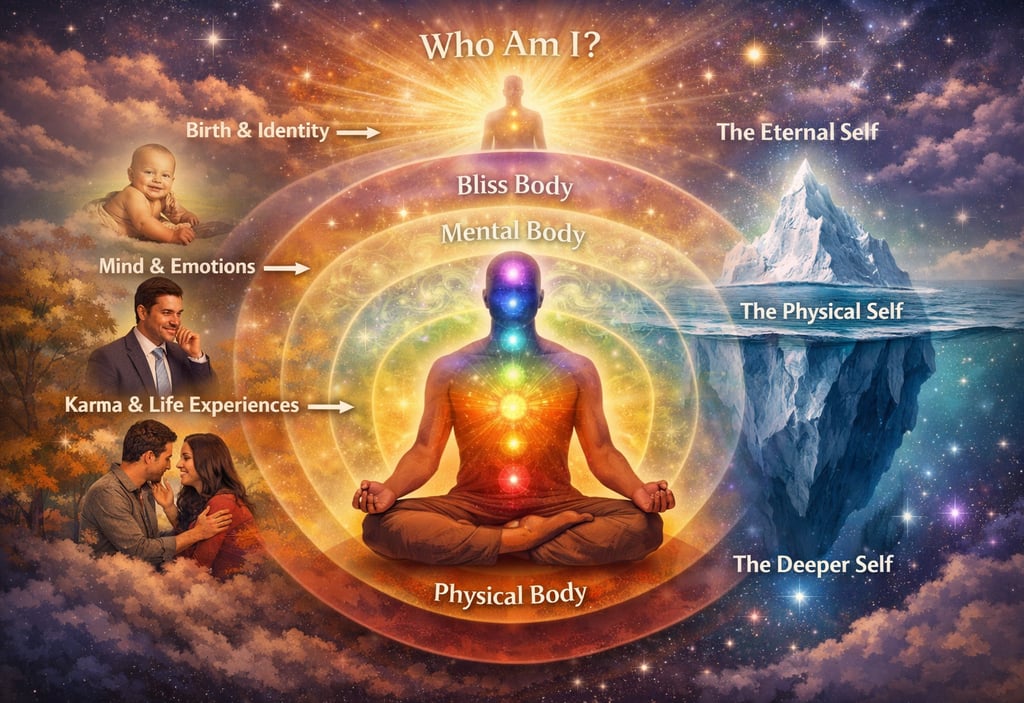
Most of us grow up believing a very simple story about who we are.
“I am this body.” “I am this mind.” “I am my name, my history, my achievements, my wounds.”
From the moment we are born, the world reinforces this idea. We are taught to care for the body, train the intellect, manage emotions, and define ourselves by roles—daughter, son, partner, professional, parent. Rarely does anyone pause to ask a deeper question:
Who is the one experiencing all of this?
Sanātana Dharma—the eternal philosophy that underlies Yoga, Ayurveda, Vedānta, and Jyotiṣa—offers a radically different answer. It does not deny the body or the mind. Instead, it gently expands our understanding, layer by layer, until we begin to see ourselves as multidimensional beings living a deeply intelligent, purposeful existence.
This is not philosophy meant to impress or intimidate. It is wisdom meant to awaken remembrance.
When you truly understand these layers—your koshas, your energy bodies, and your karmic architecture—you stop seeing life as random. You stop identifying so tightly with pain, success, loss, or limitation. And slowly, quietly, a deeper sense of peace emerges.
Let us begin where most journeys begin.
The Physical Body: The Visible Tip of the Iceberg
In Sanskrit, the physical body is called Sthūla Śarīra—the gross body. It is the most tangible, measurable, and visible aspect of our existence. Bones, muscles, organs, skin. This is the body we see in the mirror, feed every day, decorate, train, judge, and often criticize.
Sanātana Dharma does not dismiss the physical body as insignificant. In fact, it is considered sacred. It is the vehicle through which the soul experiences this plane of reality. Ayurveda calls it a temple, Yoga calls it a yantra, and Vedānta calls it an instrument.
But the key word is instrument.
An instrument is not the musician.
The physical body is shaped by:
Genetics
Prenatal influences
Past karma
Lifestyle and choices
Environment
It is born, it grows, it ages, and one day, it dissolves. Everything about it is impermanent. And yet, most human suffering arises from mistaking this temporary structure for the entirety of who we are.
Sanātana Dharma gently reminds us: You live in the body, but you are not the body.
To understand this more deeply, we move inward—from what is visible to what is subtle.
The Five Koshas: Layers of Being
The Upaniṣads describe the human being as composed of five koshas, or sheaths. A kosha is not a separate body stacked on top of another. Think of them as interpenetrating layers, each subtler than the last, all functioning simultaneously.
Like layers of an onion—or better yet, frequencies of energy—each kosha represents a dimension of experience.
1. Annamaya Kosha – The Physical Sheath
Anna means food. Annamaya Kosha is the body made of nourishment.
This is the layer we have already touched upon—the physical structure sustained by what we eat, drink, breathe, and absorb. Ayurveda works primarily at this level, using food, herbs, routine, and lifestyle to restore balance.
When this kosha is disturbed, we experience:
Fatigue
Pain
Illness
Structural imbalance
But even here, Sanātana Dharma introduces a powerful insight: the body reflects deeper layers. Chronic patterns rarely originate only at the physical level.
Which brings us to the next sheath.
2. Prāṇamaya Kosha – The Energy Sheath
If the physical body is the structure, prāṇa is the electricity.
Prāṇamaya Kosha is the field of life-force energy that animates the body. It flows through nāḍīs (energy channels) and concentrates in chakras (energy centers). Breath, circulation, nerve impulses, digestion, and vitality are all expressions of prāṇa.
This is why breath is so central in Yoga. Breathing is not just oxygen exchange—it is communication with life-force.
When prāṇa flows freely, we feel:
Alive
Motivated
Clear
Emotionally balanced
When prāṇa is blocked or depleted, we experience:
Anxiety
Lethargy
Restlessness
Brain fog
Many modern emotional issues are actually prāṇic disturbances. Yet we try to fix them purely with logic or medication, ignoring the energetic root.
Prāṇamaya Kosha teaches us something subtle but profound:
You are not just matter—you are movement.
3. Manomaya Kosha – The Mental & Emotional Sheath
This is the layer most people confuse with the self.
Manomaya Kosha includes:
Thoughts
Emotions
Memories
Conditioned reactions
Beliefs
It is the storytelling mind. The interpreter. The inner narrator constantly explaining life to itself.
This kosha is shaped by:
Childhood experiences
Culture
Trauma
Repetition
Past life impressions
In Sanātana Dharma, the mind is not the enemy. It is a tool. But when we believe we are the mind, suffering intensifies.
Why?
Because thoughts are transient. Emotions rise and fall. Yet the one observing them remains.
Manomaya Kosha is where many karmic patterns first become conscious. Fear, attachment, comparison, guilt, longing—all live here.
Yoga, mantra, meditation, and self-inquiry are designed not to suppress this layer, but to create space between awareness and mental activity.
And once that space appears, a deeper intelligence begins to emerge.
4. Vijñānamaya Kosha – The Wisdom Sheath
Beyond the thinking mind lies Vijñāna—discernment, intuition, inner knowing.
This kosha governs:
Insight
Conscience
Values
Moral clarity
Intuitive understanding
It is the voice that whispers truth without emotional drama.
Have you ever known something before you could logically explain it? That is Vijñānamaya Kosha functioning.
In Jyotiṣa, this layer is closely associated with Jupiter (Guru)—the planet of wisdom, dharma, and higher understanding.
When this kosha is strong, we:
Make aligned choices
Learn from experience
Sense when something is off
Feel guided rather than lost
When it is clouded, we repeat lessons unnecessarily.
This layer reminds us:
You are not just reacting to life—you are capable of understanding it.
5. Ānandamaya Kosha – The Bliss Sheath
The innermost kosha is the most misunderstood.
Ānanda does not mean excitement or pleasure. It means deep, causeless peace.
This kosha is experienced:
In deep meditation
In dreamless sleep
In moments of surrender
In states of profound presence
It is closest to the Self (Ātman), though still considered a sheath—not the ultimate reality.
Here, individuality softens. Fear dissolves. Time loses meaning.
Touching this layer reminds us of something ancient and reassuring:
Peace is not something you create. It is something you remember.
The Three Bodies: A Wider Framework
Sanātana Dharma also describes existence through the concept of three śarīras (bodies):
Sthūla Śarīra – Gross body (physical)
Sūkṣma Śarīra – Subtle body (mind, prāṇa, senses)
Kāraṇa Śarīra – Causal body (karmic blueprint)
The koshas fit within these bodies, with the causal body holding the deepest patterns.
This is where karma resides.
Karma: Not Punishment, But Intelligence
In popular culture, karma is often reduced to reward and punishment.
Sanātana Dharma offers a far more compassionate view.
Karma simply means action and consequence across time.
It is the memory of experience stored at subtle levels of being.
The Three Levels of Karma in Jyotiṣa
1. Sañcita Karma – Accumulated Karma
This is the vast storehouse of past impressions from many lifetimes. Not all of it manifests at once. Much of it remains dormant, waiting for appropriate conditions.
2. Prārabdha Karma – Active Karma
This is the portion of karma chosen to unfold in this lifetime. It shapes:
Birth circumstances
Body type
Family
Major life themes
Prārabdha karma is what you are working through now.
3. Kriyamāṇa Karma – Current Action
This is where free will operates. Every conscious choice you make today is shaping future experiences.
Jyotiṣa does not deny destiny—but it does not deny free will either.
It shows us where we are conditioned, and where we are conscious.
Why This Knowledge Changes Everything
When you understand these layers, something remarkable happens.
You stop asking: “Why is this happening to me?”
And begin asking: “What is this teaching me?”
You realize that:
You are not broken
You are not random
You are not limited to one lifetime, one role, or one story
You are consciousness having an experience through many layers of form.
And the more aware you become of these layers, the less trapped you feel inside any single one.
Returning to Yourself
Sanātana Dharma does not ask you to escape life.
It asks you to inhabit it more consciously.
To care for the body without obsession. To manage the mind without being enslaved by it. To honor karma without feeling victimized by it.
And slowly, gently, to remember:
You are not just this body. You never were.
You are far deeper, wiser, and more expansive than you were ever taught to believe.
And that remembrance is not the end of the journey.
It is the beginning.
Connect
Questions? Reach out anytime, we're here.
© 2026. All rights reserved.